📝 How to Create a Budget That Actually Works for You
En bref
A budget that works has 4 pillars: clear categories, a 5-minute weekly check, flexibility (a slip-up isn't failure), and a simple tool. The 50/30/20 rule or envelope method are the two most effective approaches for beginners.
How to Create a Budget That Actually Works for You
Most budgets fail within the first month. Not because people lack discipline, but because they follow a rigid template that doesn't match their real life. Here's how to create a budget that actually sticks — in 5 practical steps.
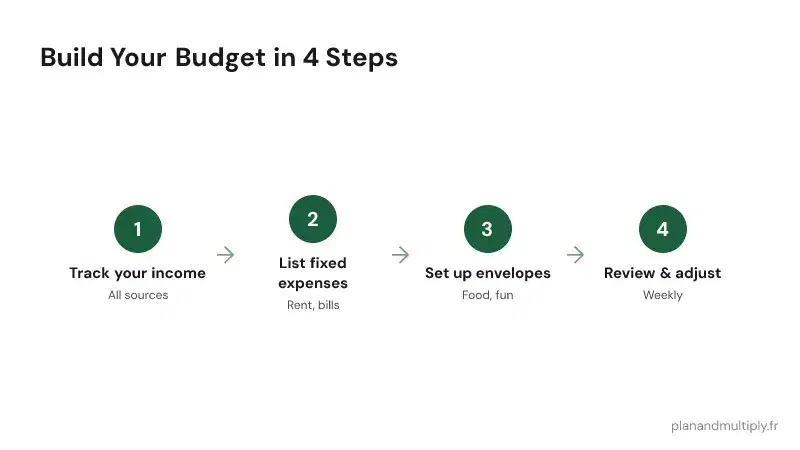
Why most budgets fail (and yours won't)
The typical advice is to track every penny, cut all pleasures, and follow the 50/30/20 rule to the letter. The problem? Life isn't a spreadsheet. Unexpected expenses happen. Social plans pop up. Your car breaks down.
A budget that works isn't about perfection — it's about direction. You need a flexible framework that absorbs real-life surprises while keeping you on track. That's exactly what the envelope method provides.
Gérez votre budget simplement
Téléchargez Plan & Multiply et passez à l’action dès aujourd’hui.
Découvrir l’app

Step 1: Calculate your real monthly income
Start with the money that actually hits your bank account each month. Not your gross salary — your net take-home pay after taxes and deductions. If you have variable income (freelancing, tips, commissions), use the average of your last 3 months to smooth out fluctuations.
Include all income sources: salary, side hustles, government benefits, rental income, investment dividends. Write down one number. This is your starting point — your financial reality. Everything else flows from here. Don't include money you might earn; only count what reliably shows up.
Step 2: List every fixed expense
Fixed expenses are the non-negotiable bills that come every month: rent or mortgage, utilities (electricity, water, gas), insurance premiums, phone plan, internet, loan repayments, subscriptions (streaming, gym, apps), and transportation costs (public transit pass, car payment).
Open your bank statements from the last 3 months and list every recurring charge. Add them up. For most people, fixed costs eat 50-65% of income. If yours exceed 70%, you likely need to renegotiate some contracts — insurance companies offer better rates to switchers, phone carriers have retention deals, and most streaming services you can pause for free.
This audit step alone often reveals $50-150/month in savings that were hiding in plain sight. Unused gym memberships and forgotten app subscriptions are the usual culprits.
Step 3: Plan your variable spending with envelopes
This is where most budgets fall apart — and where the envelope method shines. Take what's left after fixed costs and divide it into spending categories: groceries, dining out, entertainment, clothing, personal care, transportation fuel.
Assign a realistic monthly limit to each category. The key word is realistic. If you spend $400/month on groceries, don't set a $200 limit — you'll fail by week two. Start at $350 and adjust next month.
In Plan & Multiply, each category becomes a digital envelope. You'll see your remaining balance update in real time, plus your money left per day — so you always know if you're on track without mental math.
Step 4: Set a savings goal (even a small one)
Before you allocate everything to spending, set aside something for savings. Even $50/month adds up to $600/year — enough for an emergency fund starter. The trick is to treat savings as a fixed expense, not an afterthought.
Create a savings jar in Plan & Multiply with a target amount and date. The app calculates how much to set aside each month and shows your progress. Watching a savings bar fill up is surprisingly motivating and keeps you consistent.
Step 5: Track daily and adjust monthly
Log your expenses as they happen — it takes 10 seconds per purchase. At the end of each month, review your envelopes. Which ones ran out too fast? Which had money left over? Adjust the limits accordingly.
After 2-3 months, your budget will be calibrated to your actual lifestyle. You won't feel restricted because the numbers reflect reality, not wishful thinking. This is the key difference between a budget that works and one that sits in a drawer.
Common budgeting mistakes to avoid
Mistake #1: Making it too complicated. Start with 5-7 spending categories, not 20. Complexity is the enemy of consistency — a simple budget you follow beats a detailed one you abandon. You can always add more categories after your first successful month.
Mistake #2: Not including a "fun money" envelope. Depriving yourself of all pleasures leads to binge spending and guilt cycles. Budget $50-100/month for guilt-free spending on anything you want. This small allowance actually saves you money long-term by preventing emotional overspending.
Mistake #3: Giving up after one bad month. A blown budget isn't failure — it's data. Every experienced budgeter had rough months at the start. Review what happened, adjust your numbers, and try again. By month three, your budget will feel natural.
Mistake #4: Not accounting for irregular expenses. Car registration, holiday gifts, annual insurance premiums, dental visits — these predictable-but-irregular costs wreck budgets. Divide annual costs by 12 and include them as a monthly line item.
Start your budget in 10 minutes
You don't need a perfect plan to start. Open Plan & Multiply, enter your income, set up 5 basic envelopes, and begin tracking today. A rough budget you actually follow beats a perfect budget you never start. Your future self will thank you.
!À retenir
- ✓Pick one method (50/30/20 or envelopes) and test it for 3 months
- ✓Automate as much as possible (transfers, tracking)
- ✓An imperfect budget you follow beats a perfect one you abandon
- ✓5-minute weekly review is all you need
Questions fréquentes
What is the best budgeting method?▼
No one-size-fits-all. 50/30/20 for beginners, envelope method for overspenders, zero-based for detail-oriented people.
How to budget when your income varies?▼
Budget based on lowest expected income. In good months, put extra toward savings. Use a buffer account.
Écrit par
Taliane
Articles connexes
How to Make a Budget When You Don't Know Where to Start
Never made a budget before? This step-by-step guide shows you how to create your first budget in 20 minutes — no spreadsheet skills required. Real examples, real numbers, zero judgment.
How to Stop Living Paycheck to Paycheck: A Realistic Guide for 2026
69% of Americans live paycheck to paycheck in 2026 — and it's not just low-income earners. Here's a realistic, guilt-free plan to break the cycle, even when it feels impossible.
How to Stop Overspending: The Envelope Method That Actually Works
If you keep blowing your budget despite good intentions, you don't have a willpower problem — you have a system problem. Here's the fix.
Guides complets
Méthode des Enveloppes : Budget Facile Même Avec un Petit Salaire
La méthode des enveloppes budget expliquée pas à pas. Exemple concret avec 2 000€/mois + app gratuite pour passer aux enveloppes digitales sans cash.
Comment épargner pour un projet : guide étape par étape [2026]
Vacances, voiture, logement : calculez exactement combien épargner par mois pour atteindre votre objectif. Méthode concrète + suivi de progression gratuit.